Introduction: The FDA’s 2026 QMSR Rule — A Paradigm Shift in Quality Management
In 2026, the U.S. Food and Drug Administration (FDA) will fully implement the Quality Management System Regulation (QMSR), replacing the decades-old Quality System Regulation (QSR) under 21 CFR Part 820. This landmark move brings U.S. medical device regulations into alignment with ISO 13485:2016, the globally recognized standard for quality management in medical device manufacturing.
For medical device makers, this shift represents far more than a compliance update—it’s a complete reinvention of quality culture. Companies will need to rethink their systems, retrain their teams, and rebuild processes from the ground up to stay competitive and compliant in a harmonized global market.
What is the Quality Management System Regulation (QMSR)?
The QMSR establishes requirements for quality management across every stage of the medical device lifecycle—from design and manufacturing to distribution and post-market activities. Its core purpose is to enhance product safety, performance consistency, and regulatory clarity.
Unlike its predecessor (the QSR), the QMSR leverages ISO 13485’s structure, terminology, and principles. This means that while U.S. manufacturers will still answer to the FDA, their quality systems will also align with global regulatory expectations—simplifying international market entry.
Why 2026 Marks a Turning Point for Medical Device Quality Systems
The 2026 implementation is more than a deadline—it’s a transformation mandate. For years, discrepancies between the U.S. QSR and ISO 13485 created operational redundancies, duplicated audits, and inconsistent documentation. By harmonizing, the FDA aims to reduce regulatory friction, improve efficiency, and help manufacturers operate under a single, globally consistent framework.
However, achieving compliance will not be easy. Legacy systems, outdated SOPs, and inadequate documentation controls will need significant modernization.
Understanding the Transition: From 21 CFR Part 820 to ISO 13485:2016 Alignment
The FDA’s Rationale for Harmonization with ISO 13485
The FDA’s decision stems from a global shift toward unified standards. ISO 13485 is already the backbone for quality systems in Europe, Canada, and Japan. Aligning with it allows U.S. companies to reduce duplication and better integrate global supply chains.
Core Components of the FDA’s QMSR Framework
Risk Management and Documentation Standards
ISO 13485 places risk management at the heart of quality. Under QMSR, every stage—from design to post-market feedback—must include risk-based justifications and traceability documentation.
Supplier Controls and Purchasing Requirements
Manufacturers will need to validate supplier quality systems in alignment with QMSR. The FDA will expect formal supplier evaluations, contracts, and traceability measures.
Design and Development Controls under the New Regulation
Design controls will now emphasize user needs, risk mitigation, and validation evidence. Design history files (DHFs) must demonstrate traceability from initial concept to final verification.
What Medical Device Manufacturers Must Do to Stay Compliant
Reassessing and Rebuilding Your Quality Management Systems
Begin with a gap analysis comparing current QSR practices against ISO 13485/QMSR expectations. Identify non-conformances, outdated processes, and documentation deficiencies.
Updating SOPs, Workflows, and Supplier Agreements
All procedures—especially in purchasing, CAPA, and management review—must reflect QMSR terminology and risk-based thinking.
Staff Training and Change Management Essentials
The QMSR transition isn’t just procedural—it’s cultural. Invest in cross-functional training, leadership engagement, and change management to build long-term compliance readiness.
How QMSR Will Impact FDA Inspections and Audits
Inspection Readiness: What Auditors Will Now Expect
FDA inspections will increasingly resemble ISO audits, focusing on process effectiveness, documentation control, and risk traceability rather than prescriptive checklists.
Integration with ISO-Based Certification Processes
For ISO-certified manufacturers, QMSR alignment will simplify audit integration, reducing inspection fatigue and redundant corrective actions.
Leveraging Technology for QMSR Compliance
Using eQMS Platforms to Automate Compliance Processes
Electronic Quality Management Systems (eQMS) streamline document control, training management, CAPA tracking, and audit readiness—all critical for QMSR compliance.
Digital Traceability and Cloud-Based Recordkeeping
Cloud-based solutions enhance traceability, version control, and real-time collaboration, minimizing the risk of data gaps or regulatory findings.
Strategic Benefits: Turning Compliance into a Competitive Edge
While many manufacturers view the 2026 QMSR transition as a regulatory burden, forward-thinking organizations are seeing it as an opportunity to innovate and differentiate.
How Harmonization Can Boost Global Market Access
Aligning with ISO 13485:2016 provides immediate access to international markets, reducing barriers for U.S. device exports to the EU, Canada, Japan, and beyond. With a single harmonized QMS, companies can streamline regulatory submissions and reduce redundant testing or audits.
This alignment also allows multinational corporations to manage a unified quality framework, creating operational consistency across global sites and suppliers.
Improving Product Safety, Efficiency, and Brand Trust
When implemented properly, QMSR compliance enhances traceability, risk mitigation, and data-driven decision-making. These improvements directly translate to higher product reliability, fewer recalls, and greater confidence from clinicians and patients.
In a market increasingly shaped by reputation, compliance maturity becomes a strategic differentiator that boosts brand credibility and stakeholder trust.
Challenges Medical Device Companies Will Face
Cost, Time, and Resource Constraints in Transition
Transitioning from QSR to QMSR can require significant financial and human capital investment. Smaller firms, in particular, may struggle with resource allocation, documentation overhaul, and staff training.
Implementation costs include:
- QMS gap assessments
- SOP rewriting and document control updates
- eQMS software adoption
- Employee training programs
- External audits and certification alignment
However, these costs should be viewed as strategic investments, not expenses. They position companies for long-term operational resilience and compliance efficiency.
Common Pitfalls During Implementation and How to Avoid Them
Overlooking Risk Management Integration:
Many firms treat risk management as a box-checking exercise rather than a continuous process.
Solution: Integrate risk assessment into every phase—from design input to post-market surveillance.
Incomplete Documentation Mapping:
Mapping old QSR terms to ISO 13485 language can cause confusion.
Solution: Use a terminology crosswalk and standardized templates.
Insufficient Change Management:
Without employee buy-in, process reforms often fail.
Solution: Communicate early, provide consistent training, and assign internal QMSR champions.
Step-by-Step QMSR Readiness Plan for 2025–2026
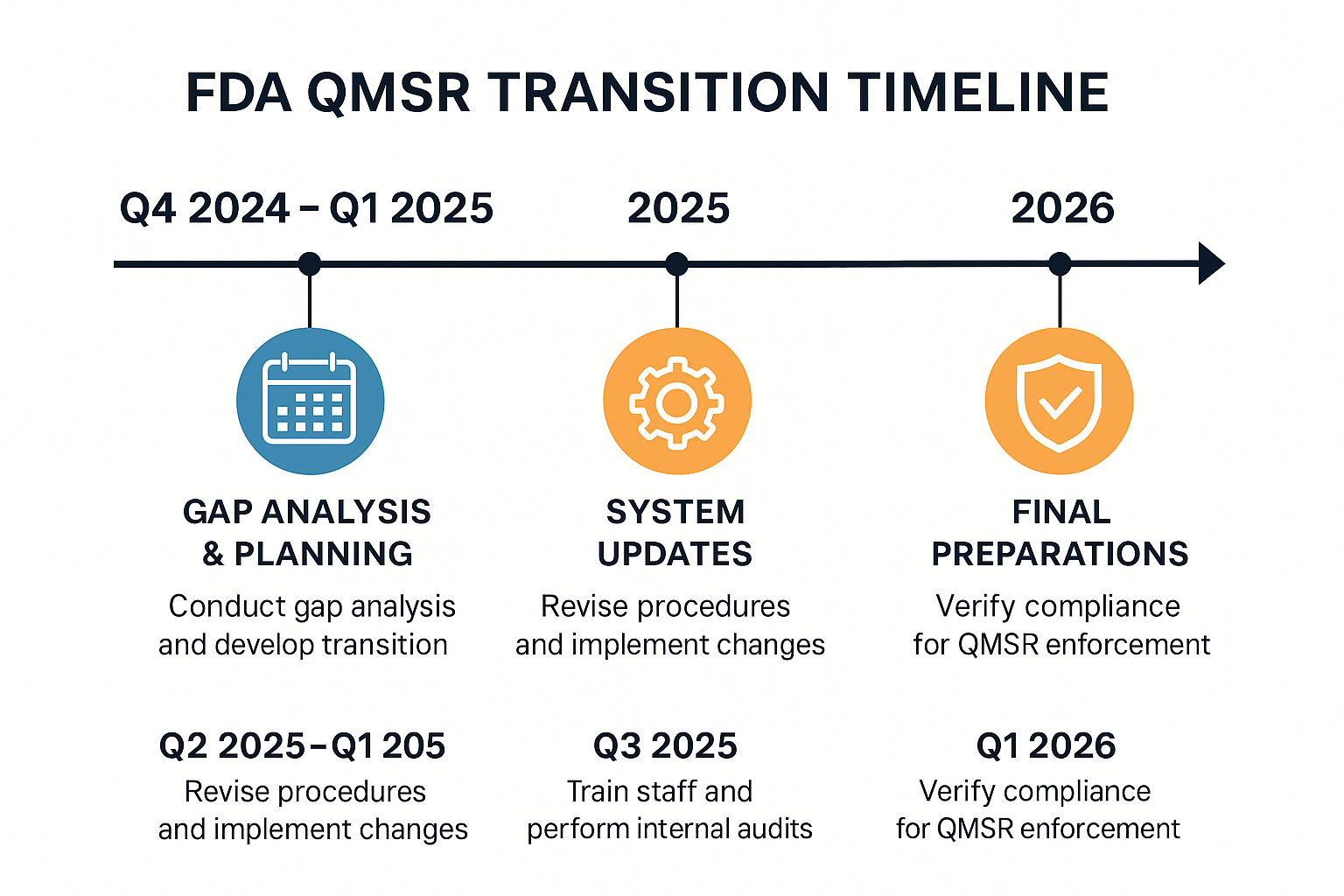
12-Month Roadmap for Implementation and Verification
| Timeline | |
| Q4 2024 – Q1 2025 | Conduct gap analysis between QSR and QMSR requirements. Assign a transition leader. |
| Q2 2025 | Revise SOPs, supplier agreements, and documentation templates. Begin risk management integration. |
| Q3 2025 | Deploy eQMS tools, train staff, and validate documentation workflows. |
| Q4 2025 | Conduct internal audits and management reviews. Address corrective actions. |
| Q1 2026 | Prepare for FDA inspections and verify alignment with ISO 13485 certification. |
Building an Internal QMSR Transition Task Force
Your transition team should include:
- Quality and Regulatory Affairs Leaders – to interpret FDA guidance.
- Operations and Manufacturing Representatives – to redesign processes.
- IT and Data Specialists – to digitize documentation.
- Executive Sponsors – to ensure funding and accountability.
Regular cross-departmental meetings will help maintain visibility and ensure consistent progress across all compliance milestones.
FAQs About FDA’s 2026 QMSR Transition
1. What is the QMSR and how does it differ from the QSR?
The Quality Management System Regulation (QMSR) replaces the FDA’s long-standing Quality System Regulation (QSR) under 21 CFR Part 820. The QMSR harmonizes with ISO 13485:2016, aligning U.S. requirements with international quality standards and emphasizing risk management and lifecycle traceability.
2. When does the QMSR take effect?
The FDA plans full enforcement in 2026, following a transition period allowing manufacturers to adapt systems, update documentation, and retrain personnel.
3. Will ISO 13485 certification automatically make a company QMSR-compliant?
Not necessarily. While ISO 13485 certification covers most requirements, QMSR also includes FDA-specific expectations such as complaint handling, labeling, and medical device reporting (MDR). Companies must ensure both standards are met.
4. How will the QMSR affect FDA inspections?
Inspections will be process-oriented and risk-based, mirroring ISO audit principles. Inspectors will assess how well your QMS integrates risk management and data traceability.
5. What are the biggest risks of not transitioning in time?
Non-compliance could lead to Form 483 observations, warning letters, or even market access restrictions. Delayed adaptation can also harm business partnerships and investor confidence.
6. How can smaller manufacturers prepare effectively?
Start early. Use consultants, digital eQMS platforms, and industry training resources to bridge internal expertise gaps. Partnering with ISO-certified suppliers can also help streamline compliance.
Conclusion: Reinventing Quality as a Catalyst for Innovation
The FDA’s 2026 QMSR transition is far more than a regulatory update—it’s a strategic inflection point for the entire U.S. medical device industry.
Manufacturers who act early will not only ensure compliance but also unlock new operational efficiencies, reduce risk exposure, and strengthen their position in global markets.
Rather than fearing change, the best organizations will view QMSR as a launchpad for continuous improvement, innovation, and trust-building across every level of their operations.